
Pure Sequences, Sets and Jokers
Use concrete card combinations to tell a pure sequence, an impure sequence, and a set apart.
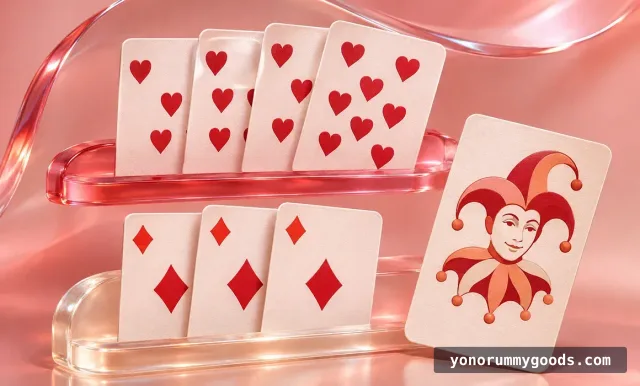
You can sort identical ranks together to find sets or sort by suit to find runs. Most beginners find a pure sequence faster by grouping by suit first. Keep a joker visibly separate until you know which missing position it should fill.
Read a group one card at a time
6♣ 7♣ 8♣ is a pure sequence. With a table that allows a joker as a substitute, 6♣ Joker 8♣ is an impure sequence if the joker stands in for 7♣. It cannot satisfy the pure-sequence requirement. A joker rank card sometimes counts naturally when it is the actual card needed by the run. Check the table’s rule before declaring.
Watch for duplicate suits and aces
7♥ 7♣ 7♠ is a set. 7♥ 7♥ 7♣ is not a valid set under the distinct-suit rule, even if the duplicate came from a second deck. If your table allows an ace at either end, A–2–3 and Q–K–A can work. K–A–2 wraps around and is invalid in the rules used here.
A quick practice drill
Deal yourself seven cards. Find one possible sequence and one possible set without using the same physical card twice. Mark the rank and suit each incomplete group needs. Repeat with a joker and ask where it helps most while leaving a pure sequence intact.
Rules reference: Pagat’s Indian Rummy rules.